

CONTACT ACES INDIANA COALITION
303 Alabama St Ste 210,
Indianapolis, IN 46204
317-238-6955
Position Statement on the Appropriate Use of Adverse Childhood Experiences (ACE) Scores
Context and Overview
The Centers for Disease Control Adverse Childhood Experiences (ACE) Study was one of the largest studies ever conducted on the long-term health impacts of child abuse and other forms of adversity. This groundbreaking study holds many lessons for public health policy and has contributed greatly to our understanding of how stressful life experiences during childhood contribute to morbidity and mortality over the lifespan and across generations. As with any study, the ACE Study has both strengths and limitations that should be carefully considered when attempting to translate findings into practice.
The Child Trauma & Resilience Committee of the Indiana Commission on Improving the Status of Children (Children’s Commission), Dr. Robert Anda, Principal Investigator of the ACE Study, and the ACE Interface Trainers in Indiana endorse the use of ACE scores for population surveillance and the design and evaluation of public health promotion and prevention strategies. ACE scores should not be used, however, for screening or diagnosing individuals or assigning individual risk for decision making about need for services or treatment. Importantly, systemic inequities may undergird the presence of ACEs in many populations and are critical to consider when assessing, interpreting, and responding to ACEs.
Surveillance of ACEs Can Inform Prevention Efforts to Improve Population Health
A robust dose-response relationship has reliably been observed between ACE scores and mental and physical health outcomes in epidemiological studies where responses are analyzed in aggregate. Understanding ACEs within a population can therefore be valuable in determining what resources and programming may be needed to reduce exposure to toxic stress and prevent associated harms within that population.
ACE Scores are Not Recommended for Individual Level Screening or Diagnosis
There is interest among some policy leaders to use ACE scores as an individual-level screening or diagnostic tool to guide decisions about need or eligibility for services. The use of ACE scores, thresholds, cut points, or ranges in this way is not recommended for the following reasons:
- The use of ACE scores for individual screening has not been evaluated by the U.S. Preventive Services Task Force (USPSTF) – an independent panel of experts that evaluates the safety and efficacy of public health screening and clinical preventive services –a national standard for instruments used in this manner.
- ACE scores can provide useful information about grouped (average) risk for many public health outcomes, but projecting those values onto any individual’s ACE score to make inferences about health, educational, or social consequences may lead to significant underestimation or overestimation of actual risk.
- The questions used in the ACE Study to define the 10 forms of adversity are incomplete measures of a person’s actual exposure to trauma and stressful life events. ACE scores do not include consideration of frequency, severity, timing or other important risk and protective factors that may influence how ACEs impact a specific person’s development and functioning. As a result, two people with the same ACE scores may have dramatically different experiences and needs.
- Individual ACE scores convey little actionable information to guide intervention planning, which is often a goal of screening. For example, a person who experienced intense, chronic, and unrelenting exposure to a single type of abuse would have an ACE score of 1 and yet may require more healthcare and other support services than someone with a higher ACE score who is generally healthy and functioning well. This is why determining a cut-off point, such as an ACE score of 4, is not accurate or appropriate.
Appropriate Use of ACEs Can Build Resilience
Research on ACEs has stimulated further research into the biology of stress and inspired meaningful changes in public policy and human services. ACE scores can offer a basis for conversations about a person’s history and to learn more about why some groups may have more challenges in their lives. Ultimately, a greater understanding and awareness of ACEs and appropriate application of ACE science can help create communities and systems that foster healing and resilience. However, the ACE score is neither a diagnostic tool nor is it predictive at the individual level. Thus, great care should be used when obtaining ACE scores for children and adults as a part of community-wide screening, service, or treatment.
This statement has been adopted by the Commission on Improving the Status of Children in Indiana (CISC).
ACEs Study and Resources
The ACEs Study
The CDC-Kaiser Permanente Adverse Childhood Experiences (ACE) Study is one of the largest investigations of childhood abuse and neglect and household challenges and later-life health and well-being.
The original ACE Study was conducted at Kaiser Permanente from 1995 to 1997 with two waves of data collection. Over 17,000 Health Maintenance Organization members from Southern California receiving physical exams completed confidential surveys regarding their childhood experiences and current health status and behaviors.
Adverse childhood experiences, or ACEs, are potentially traumatic events that occur in childhood (0-17 years). For example:
- experiencing violence or abuse
- witnessing violence in the home or community
- having a family member attempt or die by suicide
Also included are aspects of the child’s environment that can undermine their sense of safety, stability, and bonding such as growing up in a household with:
- substance misuse
- mental health problems
- instability due to parental separation or household members being in jail or prison
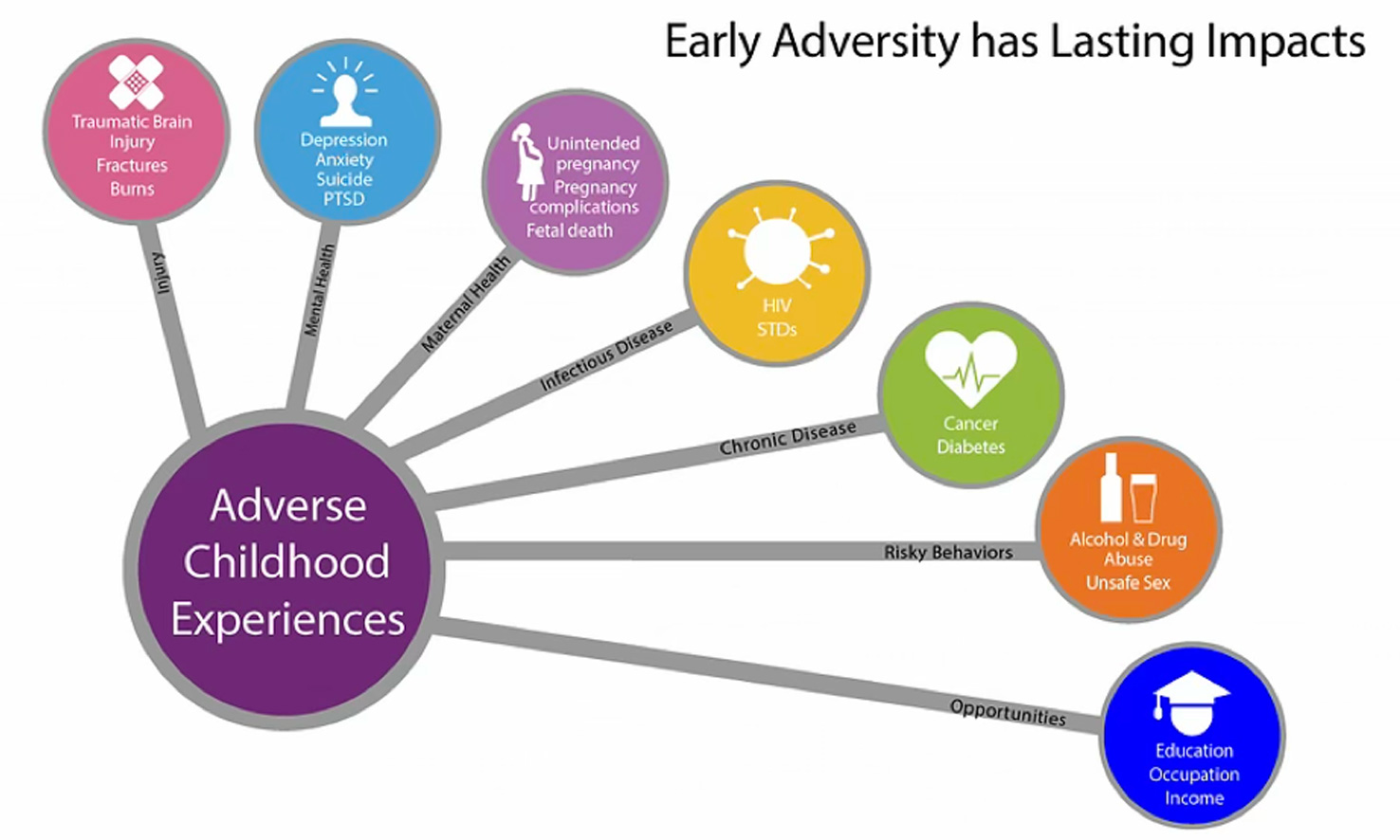
ACEs are linked to chronic health problems, mental illness, and substance misuse in adulthood. ACEs can also negatively impact education and job opportunities. However, ACEs can be prevented.
ACEs Definitions
ACE questions refer to the respondent’s first 18 years of life.
Consequences of ACEs
ACEs can have lasting, negative effects on health, well-being, and opportunity. These experiences can increase the risks of injury, sexually transmitted infections, maternal and child health problems, teen pregnancy, involvement in sex trafficking, and a wide range of chronic diseases and leading causes of death such as cancer, diabetes, heart disease, and suicide.
ACEs and associated conditions, such as living in under-resourced or racially segregated neighborhoods, frequently moving, and experiencing food insecurity, can cause toxic stress (extended or prolonged stress). Toxic stress from ACEs can change brain development and affect such things as attention, decision-making, learning, and response to stress.
Children growing up with toxic stress may have difficulty forming healthy and stable relationships. They may also have unstable work histories as adults and struggle with finances, jobs, and depression throughout life. These effects can also be passed on to their own children. Some children may face further exposure to toxic stress from historical and ongoing traumas due to systemic racism or the impacts of poverty resulting from limited educational and economic opportunities.
Major Findings
ACEs are common across all populations. Almost two-thirds of study participants reported at least one ACE, and more than one in five reported three or more ACEs.Some populations are more vulnerable to experiencing ACEs because of the social and economic conditions in which they live, learn, work and play.
The ACE score is the total sum of the different categories of ACEs reported by participants. Study findings show a graded dose-response relationship between ACEs and negative health and well-being outcomes. In other words, as the number of ACEs increases so does the risk for negative outcomes.
*All information was found through the Center for Disease Control and Prevention
